

Ever placed a football bet through an app, spun an online slot on your lunch break, or watched someone wager on an esports match while streaming? You’ve already brushed up against iGaming. So what is iGaming, in plain terms?
It’s the umbrella term for gambling you do over the internet rather than at a physical venue — casinos, sports betting, poker, bingo and more, all delivered through a website or app.
This guide covers what iGaming actually includes, how it’s regulated in the UK, how it works behind the scenes, and what to check before you sign up anywhere. The term sounds technical, but the idea is simple once you break it down — so let’s start with the definition.
What Does iGaming Actually Mean?
iGaming is commonly used as shorthand for internet gambling or online gambling. It refers to any gambling activity that takes place online rather than at a physical premises like a betting shop or casino floor.
Operators, regulators and software providers use it as a broad industry term rather than a name for one specific product — so understanding it means understanding what sits underneath it.
What is the definition of iGaming?
iGaming is the general term for gambling and wagering activities you carry out over the internet, including online casinos, sports betting, poker, bingo and daily fantasy sports. It covers the entire industry — operators, software providers, payment processors and regulators — not just the player-facing apps and websites.
What falls under the iGaming umbrella:
- Online casino games (slots, roulette, blackjack, live dealer tables)
- Sports betting and in-play (live) betting
- Online poker and bingo
- Esports betting and skin betting
- Daily fantasy sports, in some jurisdictions
What it doesn’t typically include:
- Free-to-play games with no real-money wagering
- Loot boxes and in-game purchases, which sit in a separate — and separately debated — regulatory category in the UK
- Land-based, in-person gambling (most people just call this “gambling” or “retail betting”)
The distinction between iGaming and ordinary online gaming matters for regulation, and that’s really the next thing worth clarifying.
Is iGaming the same as online gambling?
Yes — the UK market uses “iGaming” and “online gambling” interchangeably, though iGaming is the more common term within the industry itself, while “online gambling” is what you’ll see in Gambling Commission literature and consumer-facing guidance.
Best for understanding the terminology:
- Industry reports, software providers and operators tend to say “iGaming”
- Government and regulatory documents tend to say “online gambling” or “remote gambling”
- Both refer to the same set of activities
Now that the terminology is settled, it’s worth looking at what actually sits inside the category — because “iGaming” spans several quite different products.
For most of this guide, UK gambling regulation refers specifically to Great Britain (England, Scotland and Wales).
What Types of iGaming Are There?
iGaming isn’t one product — it’s a collection of distinct verticals, each with its own mechanics, regulatory nuances and player experience. Knowing the difference helps you understand what you’re actually signing up for.
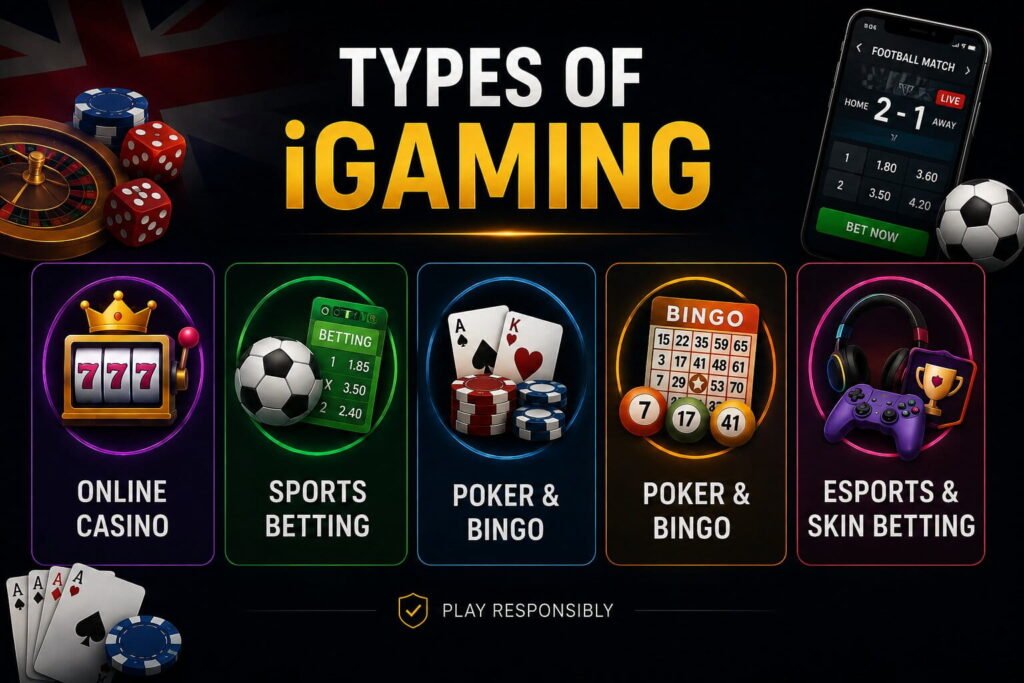
What are the main types of iGaming?
The main iGaming verticals are online casino (slots and table games), sports betting, poker, bingo, and esports/skin betting. Each operates under the same UK licensing framework but has different game mechanics, stake limits and player protections attached to it.
Online casino:
- Slots, roulette, blackjack, baccarat and live dealer games streamed from a studio
- The 2023 White Paper reforms brought in online slot stake limits, which now govern this vertical in the UK
- RNG software determines outcomes (or a live dealer handles them, for live tables), with payout rates expressed as RTP
Sports betting:
- Pre-match and in-play wagering on football, horse racing, tennis and more
- Odds move dynamically based on events and money flow
- General Betting Duty applies here rather than Remote Gaming Duty
Poker and bingo:
- Player-vs-player formats (poker) or number-draw formats (bingo), rather than player-vs-house
- Poker operators typically take a “rake” (a small cut of each pot) rather than relying on a house edge
Esports and skin betting:
- Wagering on competitive video game matches, either with cash or in-game items (“skins”)
- Gambling involving in-game items or virtual skins carries a legal status that depends on the specific activity and jurisdiction, so UK readers shouldn’t assume a skin-betting site holds a standard UK gambling licence
Each of these verticals sits on broadly the same technical and regulatory foundation, which is where the “how does it actually work” question comes in.
How Does iGaming Work?
An iGaming platform works by combining a licensed gambling operator with software from one or more game providers, a payment processor for deposits and withdrawals, and — for casino games — an RNG system that independent testers certify for fair, random outcomes. For a full technical walkthrough, see how iGaming works.
Best for understanding the moving parts:
- The operator (the brand you see) holds the licence and takes on regulatory responsibility
- Game studios (e.g. the developers behind specific slots or table games) supply the actual content
- Payment providers handle deposits, withdrawals and age/identity verification
- Independent testing labs certify that RNG and RTP figures are accurate
Caveats:
- Not every “casino” you see online is a single company — many white-label platforms run several branded sites off the same backend
- A polished front end doesn’t guarantee licensing; always verify separately
That verification point is worth taking seriously, because it’s the single biggest factor in whether an iGaming site is safe to use — which brings us to legality.
Is iGaming Legal in the UK?
Online gambling is fully legal in the UK under the Gambling Act 2005, provided the operator holds a remote gambling licence from the Gambling Commission. The Commission regulates everything from online slots to sports betting exchanges, and it maintains a public register of every licensed operator.
What UK licensing actually requires:
- Operators must hold the correct remote licence type for what they offer — casino, betting, bingo, betting intermediary and so on each have separate licence categories
- Licensed operators must follow the Licence Conditions and Codes of Practice (LCCP), covering fairness, anti-money-laundering checks and player protection
- The reforms have introduced online slot stake limits and a statutory levy, while the Gambling Commission has also introduced financial vulnerability checks and separately explored financial risk assessments for higher-spending customers
Note:
- Remote Gaming Duty rose from 21% to 40% of gross gaming yield from 1 April 2026. This is an operator tax rather than a direct tax on players.
- A licence number alone doesn’t prove trustworthiness on its own; cross-check it against the Commission’s public register rather than taking a footer logo at face value
How to check if a site is licensed?
- Search the operator’s name directly on the Gambling Commission’s public register
- Confirm the licence is active, not expired or revoked
- Check the licence covers the specific product you’re using (a bingo licence doesn’t cover casino games, for example)
Licensing tells you a platform is legally allowed to operate — but it doesn’t tell you much about fairness at the level of an individual spin or bet, which is a separate (and commonly misunderstood) piece of the puzzle.
How Do You Know if an iGaming Platform Is Fair?
A fair online casino game runs on a random number generator (RNG) that independent testers certify to determine outcomes, and it publishes a return-to-player (RTP) percentage showing the long-run payout rate. UK licensing rules require licensed operators to use certified RNG systems and disclose RTP figures.
What to look for:
- An RNG that an accredited UK testing lab has certified
- An RTP figure the operator publishes for each game (typically in the 92–98% range for slots, varying by title)
- A visible house edge on table games, which is the mathematical inverse of RTP
Best for reassurance before you play:
- Checking a game’s RTP in its info screen before staking real money
- Sticking to operators licensed specifically for the product type you’re using
None of this eliminates risk — gambling always carries the possibility of loss by design — but understanding these mechanics is what separates informed play from guesswork.
Table games work slightly differently to slots on this point, which is worth a quick note before moving on.
What’s the difference between RTP and house edge?
RTP and house edge describe the same underlying maths from opposite directions: RTP is the percentage a game pays back over the long run, while house edge is the percentage it keeps. A 96% RTP game has a 4% house edge — the two figures always add up to 100%.
Best for comparing games:
- Slots usually carry an RTP label; table games (blackjack, roulette) more often carry a house-edge label
- A lower house edge (or higher RTP) means better odds for the player over a large number of rounds — it says nothing about any single spin or hand
This distinction becomes especially relevant once you’re comparing live dealer tables against RNG-driven slots, since the two use different fairness mechanisms entirely.
How is live dealer different from RNG-based casino games?
Live dealer games stream a real dealer from a studio, and a physical wheel, cards or dice — not software — decide the outcomes, so fairness rests on video verification and dealer procedure rather than a certified RNG. Standard online slots and automated table games rely entirely on RNG software instead.
Best for players choosing between the two:
- Live dealer suits players who want a physical, verifiable outcome and don’t mind slower pacing
- RNG games suit players who want speed and don’t need to watch the mechanism generating results
- Both are equally legitimate under UK licensing, provided the operator is properly licensed for each
Caveats:
- Live dealer tables typically carry higher minimum stakes than their RNG equivalents
- The physical game rules generally fix live dealer RTP/house edge figures rather than software configuration adjusting them
Fairness mechanics are one half of choosing where to play — how you actually fund your account is the other, and UK rules here are stricter than in many other markets.
How Do You Pay and Withdraw on iGaming Sites in the UK?
UK regulators keep a tighter grip on iGaming payment methods than most other markets do, largely because of a specific harm-reduction rule that’s been in place for several years and continues to shape how operators design their payment flows.
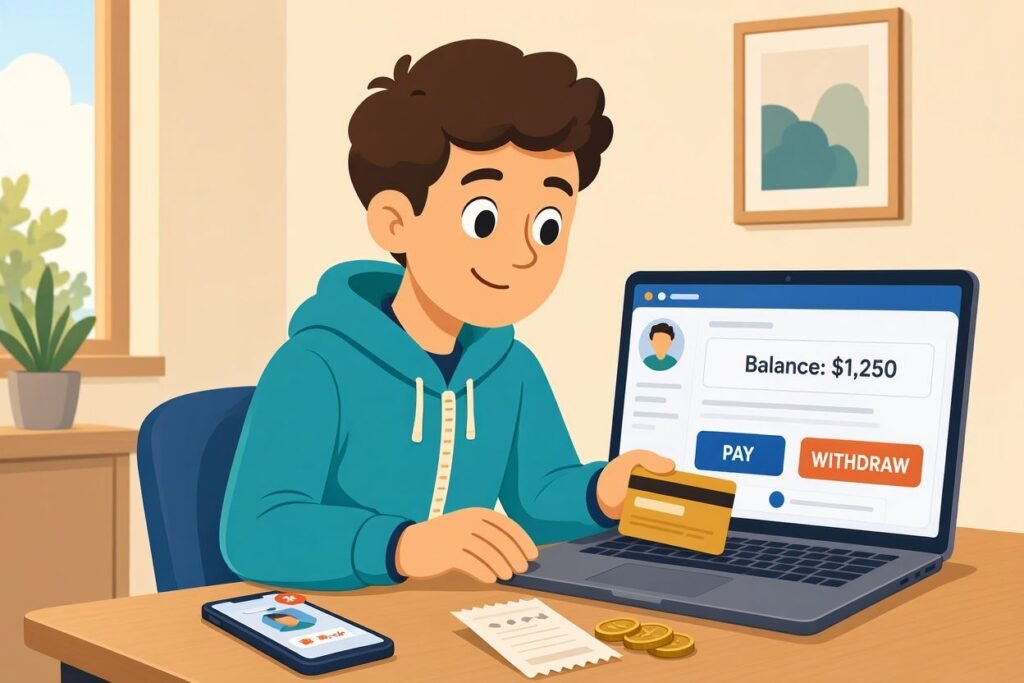
Can you use a credit card to gamble online in the UK?
No — the Gambling Commission has banned credit card use for gambling in Great Britain since April 2020, covering direct payments and credit-funded e-wallet top-ups alike. UK players must use a debit card, e-wallet, bank transfer or another approved method instead.
Best for understanding what’s allowed:
- Debit cards (Visa, Mastercard) — accepted almost universally
- E-wallets (PayPal, Skrill, Neteller) — fast, and providers now block these from taking credit-card funding to close the loophole
- Bank transfers — slower, but widely supported for larger withdrawals
- Prepaid vouchers (e.g. Paysafecard) — deposit-only at most sites, no withdrawal support
Caveats:
- Some banks flag or decline gambling-related transactions on their own initiative, separate from the Commission’s rule — check with your bank if a payment is unexpectedly blocked
- You can’t use deposit-only methods for withdrawals, so you’ll need a second method (typically your debit card or bank account) to cash out
Why this matters:
- The ban exists specifically to reduce gambling that borrowed money funds, which research has linked to greater financial harm
- It applies to every UK-licensed operator without exception — a site offering to bypass it is a clear red flag, not a convenience
Payment method choice affects withdrawal speed too, which is worth a quick, practical note before moving into how promotions work.
How long do iGaming withdrawals take in the UK?
Withdrawal times vary by method: e-wallets are typically the fastest (often within a few hours to a day), debit card withdrawals commonly take a few working days, and bank transfers can take longer depending on the operator’s verification process.
Best for faster withdrawals:
- Completing identity verification (KYC) before you need to withdraw, not after
- Using the same method for withdrawal as you did for deposit, where the operator requires it
Promotional offers are often the reason people choose one operator over another — and in the UK, regulation also shapes how operators can advertise and structure those offers.
What Are iGaming Bonuses and How Are They Regulated?
Welcome bonuses, free spins and deposit matches are a defining feature of iGaming marketing, but UK advertising rules constrain how operators can present them — which is worth understanding before comparing operators on offers alone.
How do iGaming welcome bonuses work?
Most UK operators offer a deposit match or free spins package for new players, and they attach wagering requirements that specify how many times you must play through the bonus (or the bonus plus deposit) before you can withdraw any winnings. The terms attached to a bonus matter more than its headline size.
Best for evaluating an offer:
- Check the wagering requirement multiple (e.g. 35x) before comparing headline bonus amounts
- Check which games count fully towards wagering — slots often count 100%, table games far less
- Check the time limit for clearing the bonus
Note:
- A larger bonus with a higher wagering requirement can be worth less in practice than a smaller, cleaner offer
- Operators usually hold bonus funds separately from deposited funds and may apply separate withdrawal rules to them
Are gambling adverts regulated in the UK?
Yes — the CAP Code (non-broadcast) and BCAP Code (broadcast) govern UK gambling advertising, and the Advertising Standards Authority enforces both, alongside licence conditions the Gambling Commission sets.
Licensed operators must market their services responsibly under the LCCP, and they must also follow the CAP and BCAP codes that the ASA applies.
What the rules restrict:
- Ads can’t take advantage of vulnerable people or suggest gambling can solve personal or money problems, can’t strongly appeal to under-18s, and generally can’t feature anyone under 25 or who appears to be
- As of a 2025 CAP extension, these rules now cover all UK-facing marketing by licensed operators, including non-paid social posts, influencer content and video, not just paid ads
Best for evaluating an operator’s marketing:
- Operators whose ads lean on urgency, youth appeal or “solving money problems” framing are breaching their own licence conditions, not just being pushy
- Affiliate and influencer gambling content has to meet the same standard as an operator’s own ads
Marketing rules cover how iGaming is sold to you — but there’s a whole layer of the industry operating behind the scenes that shapes what gets built and sold in the first place.
Who’s Behind an iGaming Platform? The Industry Side
iGaming isn’t only the apps and websites players use — it’s also a B2B software and services industry, and understanding that layer explains why so many “different” casino brands often feel similar underneath.
What companies make up the iGaming industry beyond the operators?
Beyond the licensed operator (the brand a player sees), the iGaming industry includes game studios that build individual slots and tables, platform providers that supply the underlying casino/sportsbook software, payment processors, and affiliate sites that refer players in exchange for commission.
Best for understanding the structure:
- Game studios — develop specific slot titles or table games, often licensing the same game to multiple operators
- Platform/aggregator providers — supply the backend software that operators build their site on top of
- Affiliates — sites (including review and guide sites) that refer players to operators for a commission, and typically disclose that relationship in a site’s terms or about page
- Payment and KYC providers — handle deposits, withdrawals and identity verification behind the scenes
Caveats:
- The same game studio’s slot can turn up on dozens of differently branded sites — the operator, not the studio, holds the licence and regulatory responsibility for how it’s offered
- Affiliate relationships are common and legitimate in UK iGaming journalism, but the site should disclose them to readers
This industry structure also explains why crypto gaming is often mentioned alongside iGaming but isn’t quite the same thing.
How Does Crypto Gaming Relate to iGaming?
Crypto gaming and iGaming overlap but aren’t identical — crypto gaming specifically involves cryptocurrency as a payment method, a game mechanic, or both, and it sits under the same UK licensing rules as any other iGaming product when real-money gambling is involved.

Is crypto gambling legal and regulated in the UK?
Gambling operators can use crypto-assets as a payment method in some circumstances, but licensed operators must meet the Gambling Commission’s payment, AML and consumer-protection requirements.
Best for understanding the distinction:
- Crypto casinos operating without any UK licence and targeting UK players are breaking the law, regardless of blockchain-based “provably fair” claims
- “Provably fair” is a cryptographic verification method some crypto casinos use instead of, or alongside, traditional RNG certification — it’s a different mechanism, not automatically a stricter one
- UK-licensed operators accepting crypto still have to meet the same anti-money-laundering and player protection standards as any other operator
Caveats:
- Crypto gaming sites are more likely than mainstream operators to be unlicensed or offshore — licence-checking matters even more here
- Currency value volatility is a real practical consideration crypto gambling adds that traditional GBP-based iGaming doesn’t have
Whichever payment method or platform type you’re using, the same safer-gambling principles apply — and they deserve more than a passing mention given how central they are to UK regulation.
What Safer Gambling Tools Are Available on UK iGaming Sites?
UK licensing rules require licensed operators to provide a specific set of player protection tools, and knowing what’s available — and free — is genuinely useful before you need it.
What safer gambling tools do UK operators have to offer?
Licensed UK operators must provide deposit limits, reality checks, time-outs and self-exclusion, and they must support GAMSTOP, the national self-exclusion scheme covering all UK-licensed online operators at once.
What’s available:
- Deposit limits — daily, weekly or monthly caps you set yourself, adjustable but with a cooling-off period before increases take effect
- Reality checks — pop-up reminders of time spent and money staked during a session
- Time-outs — short breaks (hours to weeks) during which you can’t access your account
- Self-exclusion — a longer block (6 months to 5 years); you can set this up per-site or across every UK-licensed operator at once via GAMSTOP
Best for anyone concerned about their gambling:
- GAMSTOP blocks access across all UK-licensed sites in one registration, rather than requiring separate requests to each operator
- The National Gambling Helpline (0808 8020 133, via GamCare) is free, confidential and available around the clock
These tools work because they interrupt specific patterns of harmful play — and understanding a few common misconceptions about how casino games actually behave makes it easier to use them well.
Common iGaming Myths, Explained
A handful of persistent myths shape how people misjudge risk in online gambling — worth clearing up directly, since they affect real decisions.
Are online slots “due” for a win after a losing streak?
No — RNG-based slots have no memory of previous spins; each outcome is statistically independent, so a losing streak has no bearing on the probability of the next spin winning.
People sometimes call this the gambler’s fallacy, and it applies to any RNG-driven game, not just slots.
Best for understanding why:
- RTP is a long-run average across millions of spins, not a promise that applies within any short session
- Casinos don’t adjust RNG software based on recent outcomes to “balance” a machine — certified RNG systems specifically rule this out during testing
Do higher stakes mean better odds?
No — stake size doesn’t change a game’s RTP or house edge; a £1 spin and a £10 spin on the same slot have identical odds per spin, just different amounts at risk. Higher stakes mean bigger swings, not better probability.
The myths above aren’t unique to any one vertical — they apply whether you’re talking about a slot, a roulette wheel, or an in-play football bet, which brings the whole picture back to the practical checklist any reader should run through before playing.
What Should You Check Before Using an iGaming Site?
Before depositing anywhere, a short checklist can save a lot of hassle — and protect you from unlicensed operators that only look legitimate.
Common things UK players overlook:
- Assuming a “.co.uk” domain means UK licensing — it doesn’t; check the register directly
- Not reading withdrawal terms until after a deposit, when wagering requirements can be restrictive
- Overlooking that the White Paper reforms specifically designed stake limits and deposit checks to reduce harm, not to inconvenience players
- Not setting deposit limits or self-exclusion tools (available on every licensed UK operator) before starting to play
Gambling should stay enjoyable and within your means — if it stops feeling that way, tools like GAMSTOP and the National Gambling Helpline (0808 8020 133) offer free, confidential, UK-specific support.
People Also Ask About iGaming
“iGaming” specifically refers to gambling done online; “gambling” is the broader term covering both online and in-person betting. In UK regulatory language, people often call online gambling “remote gambling.”
Yes — all licensed UK gambling operators require players to be 18 or over, with mandatory age verification during sign-up as part of LCCP compliance.
It’s much harder — unlicensed operators sit outside Gambling Commission dispute resolution, so there’s no formal route to recover funds. This is the main practical reason to check licensing before depositing.
RTP (return to player) is the percentage of wagered money a game pays back over the long run. Higher RTP doesn’t guarantee a win on any single session, but it’s a useful comparison point between games.
Broadly yes, if the operator holds a UK betting licence — but esports betting sites are a newer, faster-moving segment, so licence-checking matters even more here than with established sportsbooks.
Final Verdict on iGaming
iGaming covers the full spread of online gambling — casino, sports betting, poker, bingo and esports wagering — all running on licensed software, with independent testers certifying the RNG and operators disclosing RTP figures.
In the UK, the Gambling Commission’s licensing and the 2023 White Paper reforms (stake limits, statutory levy, affordability checks) exist specifically to keep that environment accountable.
Before using any platform, verify its Gambling Commission licence directly rather than trusting branding alone — it’s the single most reliable signal of legitimacy this guide can point you to.