

“Is this thing actually random?” is one of the most common questions I get asked about online casino games, and it’s a fair one – the answer isn’t obvious just from watching a reel spin. RNG in iGaming is the software that decides every spin, card draw, and dice roll on a licensed platform, and it’s the single piece of technology the entire fairness argument rests on.
This guide walks you through how RNG works, who checks it, and what UK licensing requires before an operator is even allowed to switch a game on.
What Is RNG in iGaming?
RNG stands for Random Number Generator — the algorithm behind every online casino outcome, from a slot reel stopping to a virtual card being dealt. It’s the digital equivalent of shuffling a deck or spinning a physical wheel, except the “shuffle” happens through mathematics rather than a human hand.
Every licensed online casino game relies on RNG to produce results that can’t be predicted or manipulated, whether that’s by the player, the operator, or anyone else. Without it, there’d be no way to guarantee that a slot machine’s outcome is genuinely independent of the last spin, or that a hand of blackjack hasn’t been rigged in the house’s favour.
How does an RNG actually generate results?
An RNG works by continuously producing long strings of numbers, even when no one is playing, using a mathematical formula seeded by an unpredictable starting value. When you hit spin or deal, the system grabs whatever number the algorithm has reached at that exact millisecond and maps it to a game outcome.
Why this matters for fairness:
- The result is fixed the instant you act — nothing after your click affects the outcome
- There’s no pattern to “time” your bets around, because the number stream never stops
- Each spin or hand is mathematically independent of the one before it
This constant, ongoing calculation is what makes RNG different from a system that only generates a number when you ask for one — and understanding that distinction matters more than it might sound.
How RNG Works Behind the Scenes
Not all random number generators work the same way, and the type used affects both cost and how a system is tested. Two categories cover almost every RNG used in regulated iGaming today.
What’s the difference between True RNG and Pseudo-RNG?
A True RNG (TRNG) pulls randomness from a physical, unpredictable source — such as electronic noise or atmospheric data — while a Pseudo-RNG (PRNG) uses a mathematical algorithm started from a “seed” value to produce results that behave randomly for practical purposes. Most online casino software runs on PRNGs because they’re faster, cheaper to certify, and easier to audit at scale.
Best for:
- PRNGs suit high-volume digital games like slots, where speed and repeatable testing matter
- TRNGs are more common in specialised or hardware-based applications, since they need physical components
Caveats:
- A PRNG is only as trustworthy as its seed and algorithm — this is exactly what test houses scrutinise
- Neither type is inherently “more fair” once properly certified; the certification process is what actually matters
The seed value is worth understanding on its own, because it’s the detail most players never think to ask about. It’s simply the starting input the algorithm uses to kick off its number sequence — usually drawn from something like system time or hardware entropy so it can’t be guessed in advance.
A predictable seed would be a serious flaw, which is exactly the kind of thing certified testing is designed to catch before a game ever reaches players. That testing process, and who actually carries it out, is where UK regulation comes in.
Is RNG in iGaming Actually Fair?
Fairness isn’t something players have to take on trust—it’s a legal requirement for any operator holding a UK Gambling Commission licence, backed by independent testing before a single game goes live.
Who tests and certifies RNG software in the UK?
UKGC-licensed operators must use a test house from the Commission’s own approved list, which currently includes labs such as eCOGRA Limited, Gaming Laboratories International (GLI), GLI UK Gaming Limited, BMM Testlabs, and iTech Global (iTech Labs), among others.
These aren’t casino-appointed reviewers — they’re independent labs the regulator itself vets and lists publicly.
Who this protects:
- Every player on a UKGC-licensed site, since certification is mandatory, not optional
- Operators too, since it gives them a defensible fairness record if outcomes are ever challenged
How the process works:
- Test houses must hold full accreditation to BS EN ISO/IEC 17025 standards, plus selected requirements from ISO/IEC 17065 and ISO/IEC 27002
- Testing includes a review of RNG documentation, research into the algorithm for known weaknesses, and a source code review to confirm the implementation matches that documentation
eCOGRA is one of the better-known names on that list — it’s an independent, internationally approved testing agency based in London that specialises in testing, inspecting, and certifying online gambling software and systems. GLI and BMM operate on a similarly global scale, testing against the same UK technical standards.
What does UKGC licensing require of RNG systems?
UKGC rules state that RNG output must be “acceptably random,” meaning operators must be able to demonstrate — through recognised statistical testing — that results are unpredictable and evenly distributed across all possible outcomes. This isn’t a one-off check; it applies for as long as the game stays live.
Best for understanding compliance:
- RNG output must be uniformly distributed across the entire output range, with outcomes matching the expected theoretical probabilities
- Outcomes must be unpredictable — computationally infeasible to guess even with full knowledge of the algorithm and every previous result
- “Adaptive” or compensated games, where the software adjusts odds based on past results, are explicitly not permitted
Problems:
- Any change to the RNG counts as a “major update” under UKGC rules, meaning it needs external retesting before release — operators can’t just tweak the software quietly
- Licence holders must submit their RNG and game test results to the Commission through its eServices digital platform as an ongoing obligation, not a box ticked once at launch
That combination — independent labs, published standards, and mandatory retesting — is what separates a regulated RNG from an unverifiable claim of “fairness” on an unlicensed site. It’s also the backdrop against which crypto gaming platforms have built an alternative approach worth understanding.
RNG vs Provably Fair Systems (Crypto Gaming)
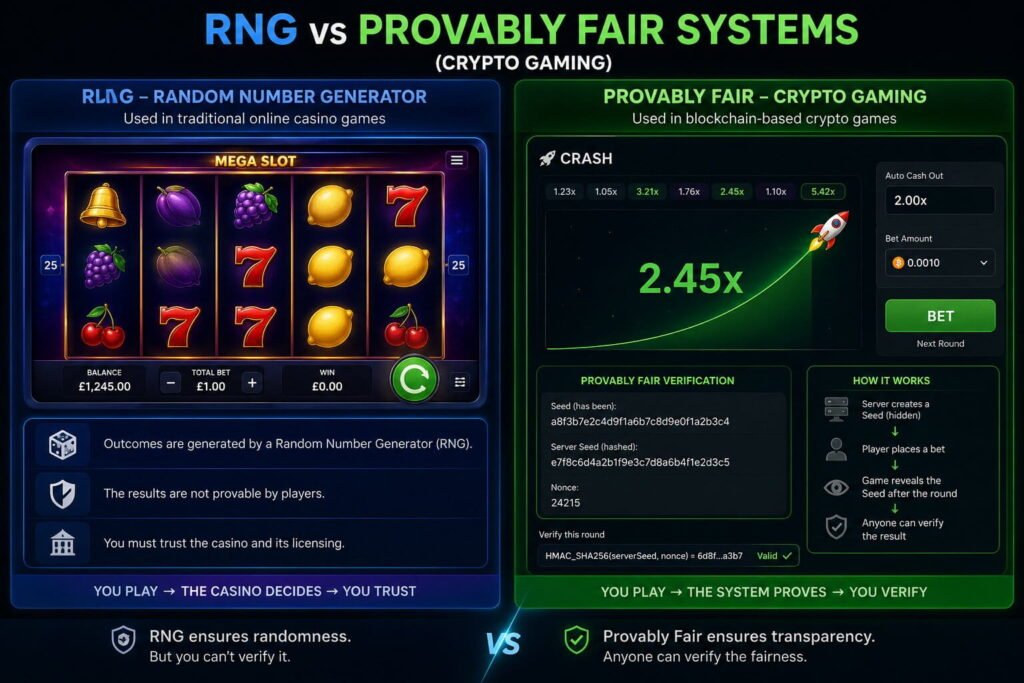
Crypto casinos often market themselves on “provably fair” technology rather than traditional RNG certification, and while the goal is the same — proving outcomes aren’t rigged — the method is genuinely different.
How is provably fair different from traditional RNG?
‘Provably fair’ uses cryptographic hashing so players can independently verify, after the fact, that a result wasn’t altered — rather than relying on a third-party lab to certify the system in advance. Traditional RNG asks you to trust the test house’s certification; provably fair asks you to check the maths yourself.
Best for:
- Players who want to personally verify individual results rather than trust a certificate
- Crypto-native platforms where blockchain transparency is part of the product’s appeal
Caveats:
- Provably fair systems aren’t automatically regulated in the way UKGC-licensed RNG is
- The two approaches solve the same trust problem differently; neither is inherently “more random” than the other when implemented correctly
Whichever method a platform uses, the practical question for most players is simpler: does the site actually hold a valid licence, and can you check its testing record?
RNG, RTP and House Edge — Not the Same Thing
One mix-up I see constantly is players treating RNG, RTP, and house edge as interchangeable – they’re not, and confusing them leads to some of the myths below.
RNG governs randomness: whether a result is genuinely unpredictable. It has nothing to do with how much a game pays back over time. That’s the job of RTP, the theoretical percentage a game returns to players across many spins, and its close cousin, the house edge, which is simply the built-in margin working the other way.
A game can have a certified, perfectly fair RNG and still carry a low RTP — fairness and generosity are separate questions entirely, and it’s worth understanding both before you judge a game on “feel” alone.
If you want the fuller picture of how these pieces fit together across a platform, our guide on how iGaming actually works covers the wider mechanics beyond just randomness.
Common Myths About RNG
That distinction between randomness and payout also explains where most casino folklore goes wrong. A surprising amount of it is built on misunderstanding how RNG actually behaves, and clearing these up is often more useful than any spec sheet.
“A slot is due a win because it hasn’t paid out in a while.” Every spin is generated independently, so previous results have no bearing on what comes next — there’s no memory built into the system.
“You can time your bet to hit a better result.” Because the RNG is generating numbers continuously in the background, clicking a fraction of a second earlier or later has no meaningful effect on the outcome you get.
“Online RNG is less fair than a physical machine.” In a licensed UK market, both are held to the same UKGC technical standards and require independent test-house certification — the format doesn’t change the fairness requirement.
Keeping these straight makes it much easier to judge a platform on what actually matters: whether it’s licensed, whether its RNG is certified, and whether that information is easy to find.
People Also Ask About RNG in iGaming
No. A certified RNG generates numbers continuously and independently, so there’s no pattern to exploit and no legitimate way to predict or influence a result.
Yes. UKGC licensing requires RNG systems to be tested by an approved test house before launch, with retesting required whenever a major change is made.
No. Both aim to prove fairness, but RNG relies on third-party lab certification, while provably fair uses cryptographic hashes players can verify themselves.
Most casino RNGs are pseudo-random, generated by algorithms rather than physical randomness — but when properly seeded and tested, they meet the statistical standard regulators require.
Initial testing happens before launch, and any major update affecting fairness triggers mandatory retesting by an approved test house under UKGC rules.
Bottom Line
If there’s one thing to take from this: RNG fairness in the UK isn’t something you take on faith. It’s a licensing requirement, checked by independent labs like eCOGRA and GLI, backed by mandatory retesting and published standards.
Crypto platforms solve the same trust problem differently, through provably fair systems, but the question stays the same either way: can the claim actually be checked?
My advice — before you play anywhere, confirm the operator holds a valid UKGC licence and current RNG certification. It’s a two-minute check that beats trusting a badge on faith.