If you have played a normal video game, the basic experience of a crypto game will not seem completely unfamiliar. You still complete quests, compete with other players, collect items and progress through the game. The difference is what happens to some of those items and rewards behind the scenes. How does crypto gaming work?
It combines conventional game systems with blockchain technology, allowing selected assets, tokens and transactions to be recorded on a blockchain.
This guide explains how the process works, where NFTs and wallets fit in, how players can earn or trade assets, and what to check before spending money.
How Does Crypto Gaming Work?
Crypto gaming works by connecting a conventional game with blockchain-based systems. The game can continue to use traditional servers for graphics, matchmaking and fast gameplay, while blockchain technology handles selected assets, ownership records and transactions.
That distinction is important because crypto gaming does not automatically mean that the entire game runs on a blockchain. Some games only use blockchain for their economy and digital assets, while more deeply integrated projects can put substantially more of the game state or rules on-chain.
If you need the broader definition first, our guide to what crypto gaming is covers the concept before you get into how the underlying system works.
What Happens When You Play a Crypto Game?
The easiest way to understand the process is to follow what happens from the moment a player starts playing to the point where they own or trade a blockchain-based asset.
1. The game handles the normal gameplay
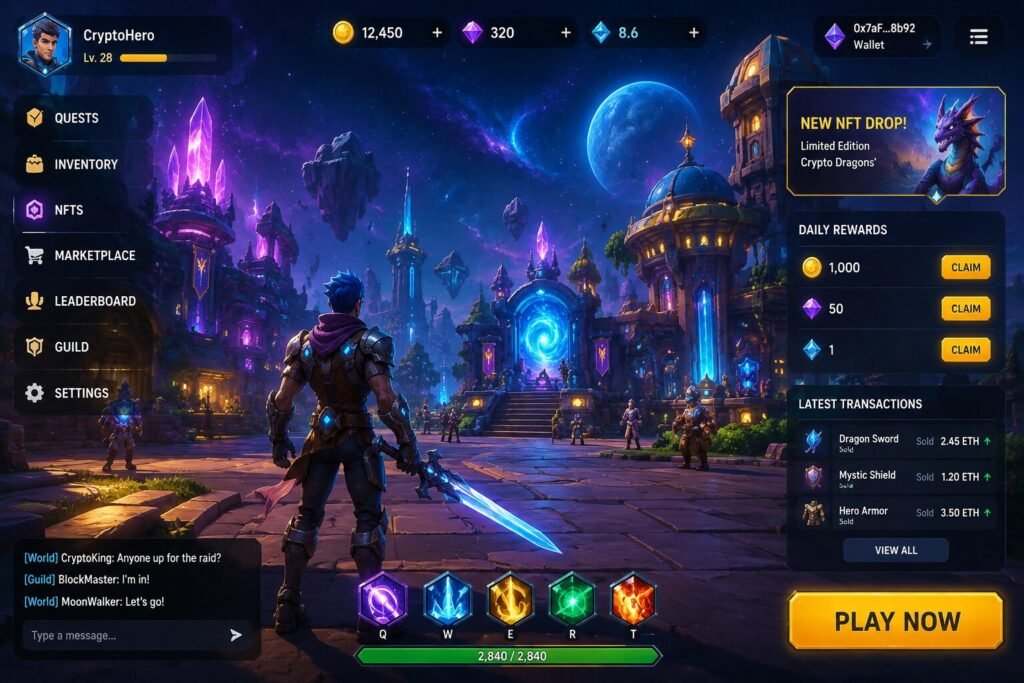
The first part can work much like a traditional game. You might complete a quest, defeat another player, collect an item or progress through a level.
Those actions do not necessarily need to be recorded individually on a blockchain. High-frequency gameplay can remain on conventional infrastructure, while blockchain is used for activities where verifiable ownership or transfer is useful.
Ethereum’s current gaming documentation describes this spectrum, ranging from games that use blockchain for particular features to games where much more of the game world operates on-chain.
2. Blockchain records selected assets
Blockchain becomes relevant when an item, token or transaction needs a verifiable record outside the game’s ordinary database.
For example, an NFT could represent a character, card, collectible or other digital asset. Instead of the ownership record existing solely inside the publisher’s database, the relevant blockchain records which wallet controls the token.
That is one of the central ideas behind blockchain gaming.
It does not, however, mean every blockchain asset is automatically valuable or useful outside its original game.
3. Your wallet connects to the blockchain side
A crypto wallet acts as the player’s connection to blockchain assets and transactions. Depending on the game, it can hold NFTs and tokens and approve transfers or other blockchain actions.
This creates an important difference from a conventional game account. Your game account mainly identifies your progress within a publisher’s system, whereas a wallet can control blockchain assets associated with a particular address.
Players therefore need to treat wallet security seriously. Connecting a wallet or approving a transaction can have consequences beyond simply changing something inside a game.
4. Smart contracts automate certain actions
Smart contracts are blockchain-based programmes that can execute predefined rules. In NFT gaming, they can govern actions such as creating, transferring or otherwise managing blockchain assets.
For example, when an NFT changes hands, the smart contract can enforce the rules governing that transfer and the blockchain can record the resulting ownership.
Not every game mechanic needs a smart contract. Developers generally use blockchain where having a transparent, verifiable record provides a useful advantage.
How Do NFTs Work in Crypto Gaming?
NFTs are commonly used to represent unique blockchain-based game assets. Depending on the project, that could include characters, cards, collectibles, equipment or other items.
The key feature is that each NFT has a distinct blockchain identity. This makes NFTs suitable for assets that need to be individually identifiable rather than interchangeable like ordinary currency tokens.
A player may therefore be able to transfer an NFT to another compatible wallet or marketplace if the game’s design allows it.
There is an important limitation, though: owning an NFT does not guarantee that another game will support it. Interoperability requires technical compatibility and developer support. An asset can remain in a wallet while losing its usefulness if the original game or supporting ecosystem disappears.
For a more detailed explanation, see our guide to NFTs in crypto gaming.
What Are Crypto Gaming Tokens Used For?
Crypto gaming tokens are fungible digital assets used within blockchain gaming ecosystems. Their specific purpose depends on the game.
A token might function as:
- An in-game currency
- A gameplay reward
- A payment method for certain assets
- A governance mechanism
- Part of the game’s wider economy
Some projects use more than one token, with different assets serving different purposes. Current guides on GameFi also distinguish between reward currencies and broader utility or governance tokens.
The important point is that a token reward is not the same as guaranteed income. Its market value can change, and players may also face transaction or conversion costs.
How Do Players Earn Crypto From Games?
Players can earn blockchain-based rewards through different game mechanics. These can include completing quests, winning battles, progressing through a game, creating assets or contributing to an ecosystem. Rewards may take the form of tokens or NFTs.
This is where the term play-to-earn comes in. Our guide to what play-to-earn gaming is covers that model in more detail.
However, the phrase can create the wrong expectation. A player receiving 10 game tokens has earned an asset, but that does not tell you what those tokens will eventually be worth.
Can Crypto Games Actually Make You Money?
They can provide assets with monetary value, but crypto games should not be treated as guaranteed sources of income. Token prices can fall, NFT demand can disappear and the costs involved in acquiring or trading assets can reduce or eliminate a player’s return.
This is one of the most important practical differences between earning something in a game and making a financial profit from it.
Research into NFT games has also found that profitability is far from evenly distributed among players, with a 2026 study of 12 games finding that players in most of the games studied had negative average profits from NFT trading.
What Happens When You Sell a Crypto Gaming Asset?
If a game supports transferable assets, the process can involve moving an NFT or token through a compatible marketplace or blockchain transaction.
A simplified example is:
- You earn or purchase a blockchain-based asset.
- The asset is associated with your wallet.
- You list or transfer it through a compatible marketplace.
- Another user purchases or receives it.
- The blockchain records the transaction.
- You receive the agreed asset or payment, less any applicable fees.
The exact process varies considerably between games and blockchain networks.
Some games keep their assets within a closed ecosystem, while others allow players to interact with external wallets and marketplaces. Never assume that an item is transferable simply because a game describes itself as a blockchain or NFT game.
Crypto Gaming vs Traditional Gaming
The biggest difference is the treatment of digital assets and economic transactions.
| Feature | Traditional gaming | Crypto gaming |
|---|---|---|
| Game items | Usually controlled within the publisher’s system | Some can exist as blockchain assets |
| Ownership record | Publisher’s database | Blockchain for supported assets |
| Trading | Usually limited to game systems | May allow external trading |
| Rewards | Usually have in-game value | Can include tokens or NFTs |
| Wallet | Generally unnecessary | May be required or supported |
| Financial exposure | Mainly purchase-related | Can include token and NFT market risk |
Crypto gaming therefore does not replace conventional game development. It adds another layer for ownership, transactions and digital economies.
What Should You Check Before Spending Money?
This is where crypto gaming deserves more scrutiny than a normal game purchase. Before connecting a wallet or buying an asset, look beyond the token price.
Check these points first:
- What do you actually own? Find out whether the item is genuinely represented by an NFT or is simply an in-game database entry.
- Where is the asset stored? Check which blockchain and wallet system the game uses.
- Can you transfer it? Read the game’s rules before assuming an asset can be sold or moved elsewhere.
- What are the costs? Account for network fees, marketplace fees and any required purchases.
- What gives the token value? Look for genuine utility rather than relying solely on speculation.
- What happens if the game closes? Blockchain ownership may remain, but the asset’s usefulness can disappear.
- How does the reward economy work? Understand where rewards come from and whether the system depends on continually attracting new players.
These checks can reveal problems that are easy to miss when a project focuses heavily on token prices or NFT sales.
Ownership, Utility and Value Are Different
The most useful question is not simply “Can I own this item?” It is “What does that ownership actually allow me to do?”
An NFT can be verifiably owned by your wallet while still having limited practical value. Its usefulness might depend entirely on the original game, its player base, its marketplace and continued developer support.
That creates three separate concepts that players should not confuse:
Ownership: the blockchain shows that your wallet controls the asset.
Utility: the game or another compatible platform gives that asset a function.
Value: another person is willing to exchange something for it.
Those three things can exist independently. An asset can have verifiable ownership but little utility. It can have utility but fall in market value. It can have market value while depending heavily on a particular game’s continued popularity.
That distinction is one of the best ways to evaluate whether a crypto game’s blockchain features genuinely add something to the experience.
Are Crypto Games Safe?
Crypto games introduce risks that ordinary games generally do not. These include wallet security problems, phishing, malicious transactions, token volatility, NFT price declines and projects that fail to maintain an active ecosystem. Current 2026 guides continue to highlight both financial and security risks in NFT and play-to-earn gaming.
That does not mean every crypto game is unsafe. It means players should treat the blockchain side of the experience as a separate security and financial consideration.
Before connecting a wallet:
- Verify the official game website.
- Check exactly what transaction you are approving.
- Never share your wallet’s recovery phrase.
- Avoid buying an asset simply because its price is rising.
- Understand the game’s fees and withdrawal process.
- Research whether the asset remains useful if the game’s popularity declines.
Final Verdict
Crypto gaming works by combining familiar game mechanics with blockchain-based ownership, tokens and transactions. The blockchain does not necessarily run the entire game; in many cases, it handles selected assets and economic functions while conventional infrastructure manages the gameplay.
For players, the biggest change is the relationship with digital assets. You may be able to own, transfer or trade certain items rather than keeping them entirely inside a publisher’s ecosystem. But ownership alone does not guarantee utility or financial value.
Understanding those differences is the key to approaching crypto gaming realistically rather than treating every blockchain game as a way to make money.