

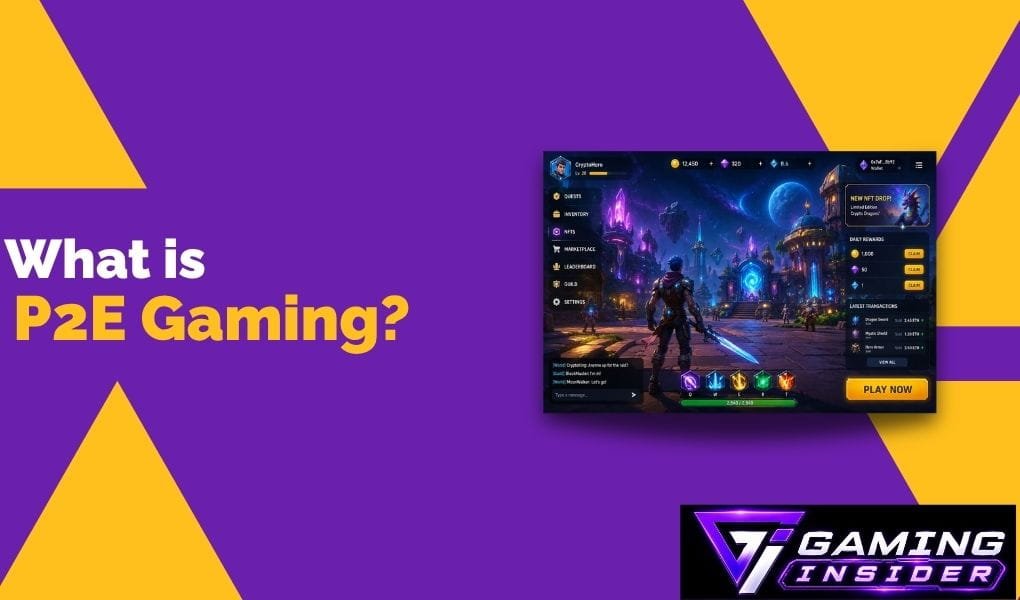
If you have seen games promising cryptocurrency, NFTs or tradeable rewards, you have probably come across play-to-earn gaming. The basic idea is straightforward: play a game, earn digital assets and potentially trade them for value outside the game.
The reality, however, depends heavily on the game’s economy, token demand and ownership model.
This guide explains what P2E gaming means, how the reward system works, what players can earn and the risks worth checking before spending money. It also gives you a practical way to judge whether a P2E game is worth your time.
What Is Play-to-Earn Gaming?
Play-to-earn (P2E) gaming is a blockchain-based gaming model where players can receive cryptocurrency, NFTs or other digital assets through gameplay. Unlike conventional in-game rewards, supported blockchain assets can potentially be transferred or traded outside the game.
The important distinction is digital ownership and transferability. Traditional games can give players skins, currency or equipment, but those items normally remain within the publisher’s ecosystem. Blockchain-based assets can instead be recorded on a blockchain and held through a compatible wallet.
P2E is therefore part of the wider blockchain gaming sector rather than a completely separate type of game. For the underlying technology, see our guide to how blockchain works.
How Do Play-to-Earn Games Work?
A typical P2E system connects gameplay with a blockchain-based economy. Players complete activities, receive eligible rewards and may then use, hold or trade those assets depending on the game’s design.
The basic process is:
- Play — complete quests, challenges, battles or other activities.
- Earn — receive a token, NFT or another eligible asset.
- Store — move supported assets to a compatible crypto wallet when permitted.
- Use or trade — assets may have gameplay utility or be traded through supported markets.
- Cash out — tradeable cryptoassets can potentially be exchanged through compatible services, subject to their rules and fees.
Not every blockchain game follows this exact structure. Some use blockchain mainly for ownership, while others build a larger economic system around tokens and NFTs.
For a broader explanation, read our guide to how crypto gaming works.
What Can You Earn From P2E Games?
The reward depends on the game’s economic design. Two of the most common assets are fungible tokens and NFTs, although the way they are earned and used varies between projects.
Crypto tokens
Some games distribute tokens for completing gameplay activities or contributing to the game’s ecosystem. These tokens may have a market value, but that value can change substantially.
NFTs
NFTs can represent unique blockchain-based assets, including certain game characters, items or other digital property. Whether an NFT is useful or tradeable depends on the specific game’s ecosystem.
You can learn more about this asset class in our guide to NFTs in crypto gaming.
Can You Actually Make Money From P2E Games?
P2E games can provide digital assets with monetary value, but they should not be treated as guaranteed income. Token prices, NFT demand, reward rates, transaction costs and marketplace liquidity can all affect what a player ultimately receives.
Binance Academy identifies volatile token prices, upfront costs and unsustainable tokenomics among the key risks associated with P2E gaming.
This is an important distinction that is sometimes lost in P2E marketing: earning an asset is not the same as earning a reliable profit.
A player could receive tokens while their market value falls. Similarly, an NFT may technically be tradeable but have little demand from other players.
That means the health of the game’s economy matters just as much as the advertised reward.
The P2E Sustainability Check
One of the most useful ways to assess a P2E game is to stop asking “How much can I earn?” and ask “Why does this economy need players to keep participating?”
This gives you a more realistic picture of the project.
| Check | What to investigate |
|---|---|
| Gameplay | Would the game still be enjoyable without financial rewards? |
| Reward source | Where do the rewards actually come from? |
| Token supply | Can new tokens enter circulation faster than demand grows? |
| Token sinks | Are there meaningful ways for tokens to be spent or removed from circulation? |
| Asset utility | Do NFTs or tokens have a genuine purpose within the game? |
| Player demand | Why would another player want to buy the asset? |
| Entry cost | Do you need to spend money before accessing important features? |
| Liquidity | Can assets realistically be traded when you want to sell? |
This is where the newer P2E conversation differs from the original “play and get paid” pitch. Recent industry analysis has placed greater emphasis on sustainable tokenomics, gameplay quality and reward systems that do not depend entirely on constantly attracting new players.
Play-to-Earn vs Traditional Gaming
The biggest difference is not simply that P2E games offer rewards. Traditional games already reward players with items, currencies and progression.
The difference is that supported blockchain assets can be owned and transferred through blockchain infrastructure, rather than existing solely inside a publisher-controlled database.
| Feature | Traditional gaming | P2E gaming |
|---|---|---|
| In-game rewards | Yes | Yes |
| Cryptocurrency rewards | Generally no | Possible |
| NFTs | Generally no | Possible |
| Blockchain ownership | No | Possible |
| External trading | Usually restricted | Possible for supported assets |
| Asset value outside game | Usually limited | Potentially available |
However, blockchain ownership does not automatically mean an asset is valuable. The game’s rules, marketplace activity and player demand still determine its practical usefulness.
What Are the Risks of Play-to-Earn Gaming?
The main P2E risks are volatile asset prices, changing reward systems, upfront costs, weak marketplace demand, wallet security issues and unsustainable game economies. These risks mean players should treat P2E rewards differently from guaranteed earnings.
Before spending money, check:
- How much the game requires upfront
- Whether rewards can actually be withdrawn or traded
- Transaction and marketplace fees
- Token supply and distribution
- Whether the game has genuine gameplay value
- How the project handles wallet and account security
- Whether the developers continue to maintain the game
A UK point worth knowing
If you are in the UK, cryptoasset rewards can also have tax implications depending on how they are received and later disposed of. HMRC states that the tax treatment depends on the circumstances, with different rules potentially applying to income and gains. Keeping accurate records of transactions and values is therefore important.
This is separate from gambling regulation. If a product actually involves gambling rather than ordinary gameplay, different UK rules can apply; the Gambling Commission specifically addresses cryptoassets and virtual currencies in gambling contexts.
Are Play-to-Earn Games the Same as Crypto Games?
No. Play-to-earn is a model within the broader crypto and blockchain gaming sector. A crypto game can use blockchain technology, NFTs or cryptoassets without making earning money the central purpose.
This distinction matters because modern blockchain games increasingly use digital ownership and player economies without relying entirely on the promise of financial rewards.
People Also Ask About Play-to-Earn Gaming
Some games offer free entry, while others require purchases for certain features or earning opportunities. Check the current requirements before spending anything.
Not always. However, a compatible wallet may be needed to receive, store or transfer blockchain assets, depending on the game’s design.
There is no universal guarantee. Check the developer, token economy, wallet requirements, trading arrangements and project activity before committing funds.
No. P2E games can use fungible tokens or other reward systems without making NFTs a central part of the experience.
Yes, but the model has matured. Current P2E discussions place more emphasis on gameplay quality, sustainable economies and useful digital ownership rather than simply promising players easy income.
Research and Sources
| Source | Why it is useful |
|---|---|
| DappRadar | Background on P2E and the development of blockchain gaming models |
| Binance Academy | P2E mechanics, cashing out and major risks |
| Kraken Learn | Explanation of blockchain rewards, NFTs and player ownership |
| HM Revenue & Customs | UK guidance on cryptoasset tax treatment |
| UK Gambling Commission | UK regulatory context where cryptoassets and gambling overlap |
Bottom Line
Play-to-earn gaming combines conventional gameplay with blockchain-based rewards and digital ownership. The opportunity is real, but so are the economic risks.
The strongest way to assess a P2E game is to look beyond its token price: examine the gameplay, reward source, token supply, asset utility, player demand and trading conditions.
If the game remains worthwhile without the promise of easy money, its economic model has a stronger foundation. For UK players, also consider the tax treatment of cryptoasset rewards and keep appropriate transaction records.